An uncertified installer can lead to the cancellation of the manufacturer’s warranty on certain models of professional hoods. Despite the growth of recommendation platforms, official certifications remain the most reliable criterion for assessing the competence of a technician. Non-compliance with installation standards exposes establishments to administrative penalties and increased safety risks.
The price difference between two quotes does not always reflect the quality of service or compliance with current regulations. Intervention times and the availability of spare parts vary greatly among installer networks, complicating the selection of a professional truly suited to each project.
Understanding the stakes of a professional kitchen hood
The kitchen hood is not just an auxiliary device. In the restaurant sector, it becomes the central pillar of the daily fight against smoke, grease, and odors. Its mission: to maintain an air quality compatible with hygiene and safety requirements. The professional hood continuously renews the atmosphere, reduces deposits on walls, limits overheating, and prevents fire outbreaks. Installation requires the utmost rigor: any deviation from the rules can put a restaurant in difficulty, even leading to a suspension of operations.
Two major systems share the market: the ducted hood, which expels air outside through a duct, and the recirculating hood, which purifies the air using charcoal and grease filters before returning it to the room. The choice is made based on the type of establishment, whether it is an open kitchen, snack bar, or food truck, and the configuration of the premises. A high-performance kitchen hood must match the power of the cooking equipment and the volume of the room, or it risks repeated breakdowns or malfunctions.
Improvisation is not an option with hygiene and safety standards. Only a compliant installation protects teams and customers from undesirable emissions. Finding a truly competent kitchen hood installer requires a perfect mastery of technical and regulatory aspects (see: Who can install a kitchen hood? – Côté Déco). Given the diversity of models, extraction hood, filter hood, ventilation hood, regular maintenance is essential to maintain the system’s efficiency.
What criteria should you prioritize when choosing the hood that suits your needs?
The range of kitchen hoods is vast: models, technologies, finishes, there is something for every project. Before settling on a reference, assess how you will use it and examine the precise configuration of your space. Surface area, ceiling height, type of cooking plate, overall organization: each parameter matters in the final choice.
The airflow rate is the top criterion: it should allow for air renewal in the room between 10 and 15 times per hour. An insufficient airflow lets odors and vapors escape. Conversely, a device that is too powerful can quickly become deafening and energy-hungry. Pay attention to the noise level: favor models below 60 dB to maintain a pleasant atmosphere, especially in open kitchens.
The extraction mode depends on the technical possibilities of the building. If no extraction duct is feasible, opt for a recirculating hood equipped with active charcoal filters, which need to be replaced regularly. Regarding grease filters, frequent cleaning is crucial for the device’s efficiency, regardless of the chosen system.
Appearance and integration mode matter, but should not overshadow performance. Wall-mounted, island, built-in, or retractable: ensure compatibility with the cooking plate. The energy label, now mandatory, provides useful benchmarks on consumption, suction efficiency, and noise generated.
To guide this choice, here are the main criteria to examine:
- Airflow rate: suitable for the volume
- Noise level: below 60 dB
- Filters: regular maintenance and replacement
- Mode: extraction or recirculation depending on configuration
- Compatibility: size of the plate and style of the kitchen

Hiring a qualified installer: expert advice and best practices
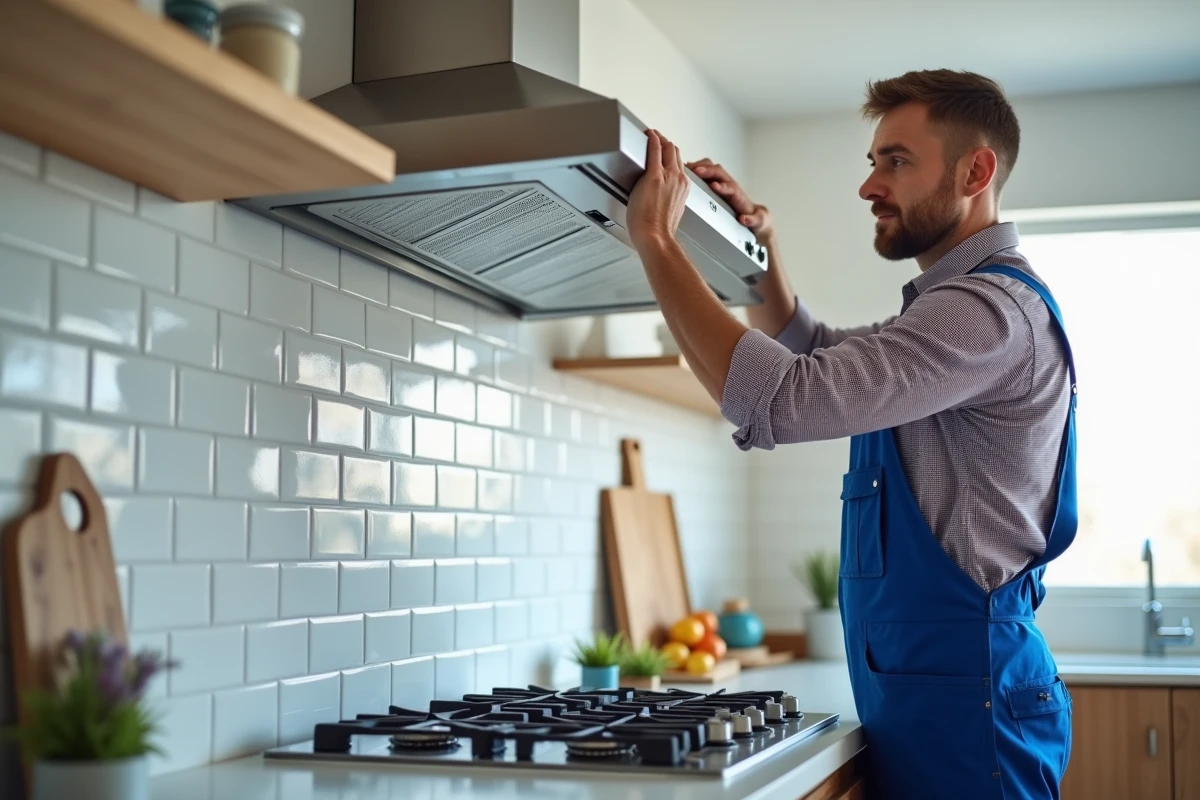
Entrusting the installation of a kitchen hood to a competent professional is neither random nor improvised. First and foremost, ensure that the technician is well-versed in current standards and has solid experience, whether it concerns a residential hood or a professional kitchen hood. The stakes go far beyond the physical installation: a poorly executed installation leads to noise disturbances, poor extraction, and risks of backflow or safety issues.
A trustworthy specialist knows how to assess the site’s specifics and advise on the choice of system, extraction or recirculation, based on the technical feasibility of the connection. They check the tightness of connections, compliance with safety distances, the conformity of the electrical supply, and the installation of backflow prevention devices. Beyond the installation, the quality of after-sales service, support for maintenance (cleaning filters, checking the motor, inspecting the duct), and responsiveness in case of breakdowns are points not to be overlooked.
The intervention of an experienced installer preserves the longevity of the hood, whether it is a domestic appliance, a restaurant kitchen, or a food truck. Seek a professional with recognized insurance and certifications (NF, Qualibat, or equivalent). Do not hesitate to ask for references, demand a detailed quote, and verify transparency regarding completion times and follow-up. Ultimately, a professional installation determines not only performance but also the control of odors, vapors, and greases and the overall safety of the extraction system.
A well-installed hood promises a calm kitchen, where air flows smoothly and activities run smoothly. Technical requirements are never a luxury, but the discreet foundation of a serene daily life behind the stove.