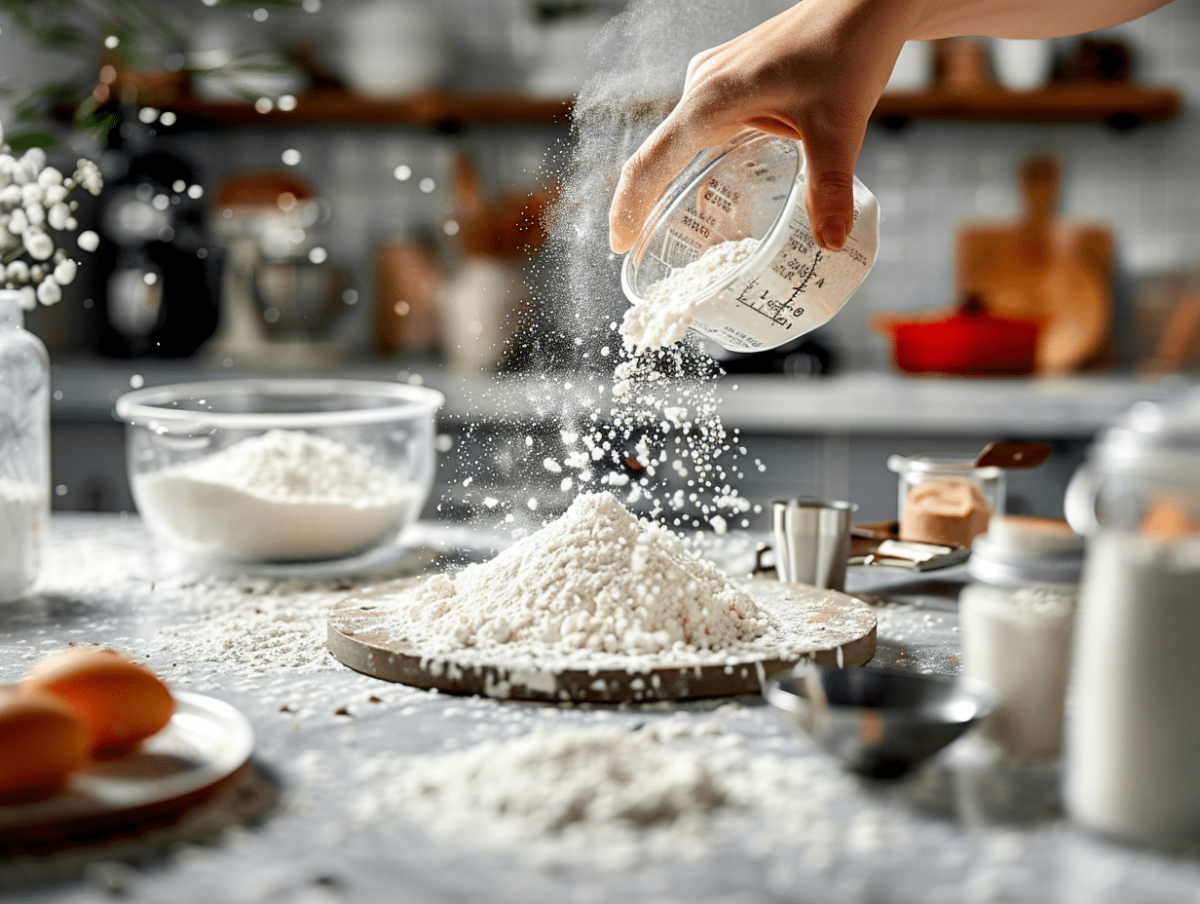
Precision is essential in cooking, especially when it comes to following recipes that require exact measurements. Home cooks often face a challenge when they need to convert grams, a unit of weight, into milliliters or measuring spoons, which are units of volume. This conversion can be complex as it varies according to the density of each ingredient. For example, a gram of salt will not take up the same volume as a gram of flour. Understanding how to make these conversions accurately is therefore fundamental to culinary success.
Understanding the Basics of Measurement Conversion in Cooking
Cooking requires a mastery of measurements and conversions to ensure the success of recipes. These often involve a transposition of mass into volume, an operation that is not uniform for all ingredients due to their varying densities. The liter, fundamental in understanding liquids, is equivalent to one kilogram or 1000 grams. For solid ingredients, such as flour, the process requires extra attention. Take flour as an example, for which the equivalent weight must be divided by two: 250g of flour in glass does not represent the same volume as 250g of water.
Let’s delve deeper into the question of common containers. A coffee cup, for example, holds 100 milliliters or 100 grams, depending on whether you are measuring a liquid or a solid with a density similar to water. This equivalence cannot be directly applied to all ingredients, as their density can vary significantly. The density, remember, dictates the relationship between the weight and volume of a substance, a relationship that is not a universal constant.
To ensure proper conversion, equip yourself with a kitchen scale and graduated containers like measuring cups. For small quantities, note that a teaspoon is equivalent to 5 milliliters or about 0.5 grams, making it a precise measuring tool for spices, salt, or sugar. Remember that the accuracy of measurements greatly influences the final texture and taste of your preparations. Even though these conversions may seem complex, once mastered, they will pave the way for a culinary experience that is both precise and creative.
Techniques and Tips for Converting Grams to Volume
In the culinary arsenal, the kitchen scale and measuring cup remain essential allies for a faithful transposition of grams into volume. Consider the example of a coffee cup: it contains 100 milliliters or 100 grams of a substance with the density of water. This equivalence is disrupted when it comes to lighter or denser ingredients. To convert grams of substances like powders or cereals, precise weighing with a scale is indispensable.
When precision is key, the teaspoon proves to be a finely tuned measuring tool. For powdered ingredients or those requiring precise measurements in small quantities, the teaspoon offers an equivalence of 5 milliliters or approximately 0.5 grams. This precision is particularly crucial for components such as salt, baking soda, or baking powder, where the accuracy of proportions directly impacts the final result of a pastry or dish.
Regarding conversions involving larger volumes, familiarize yourself with the equivalences between liquid measurement units: one liter is divided into 10 deciliters, 100 centiliters, or 1000 milliliters, and for solids, the density of the ingredient dictates the amount. The dialogue between weight and volume does not occur on equal terms; it is a conversation where each ingredient whispers its weight differently according to its density. A keen understanding of these nuances opens the door to precise application and, by extension, successful cooking.